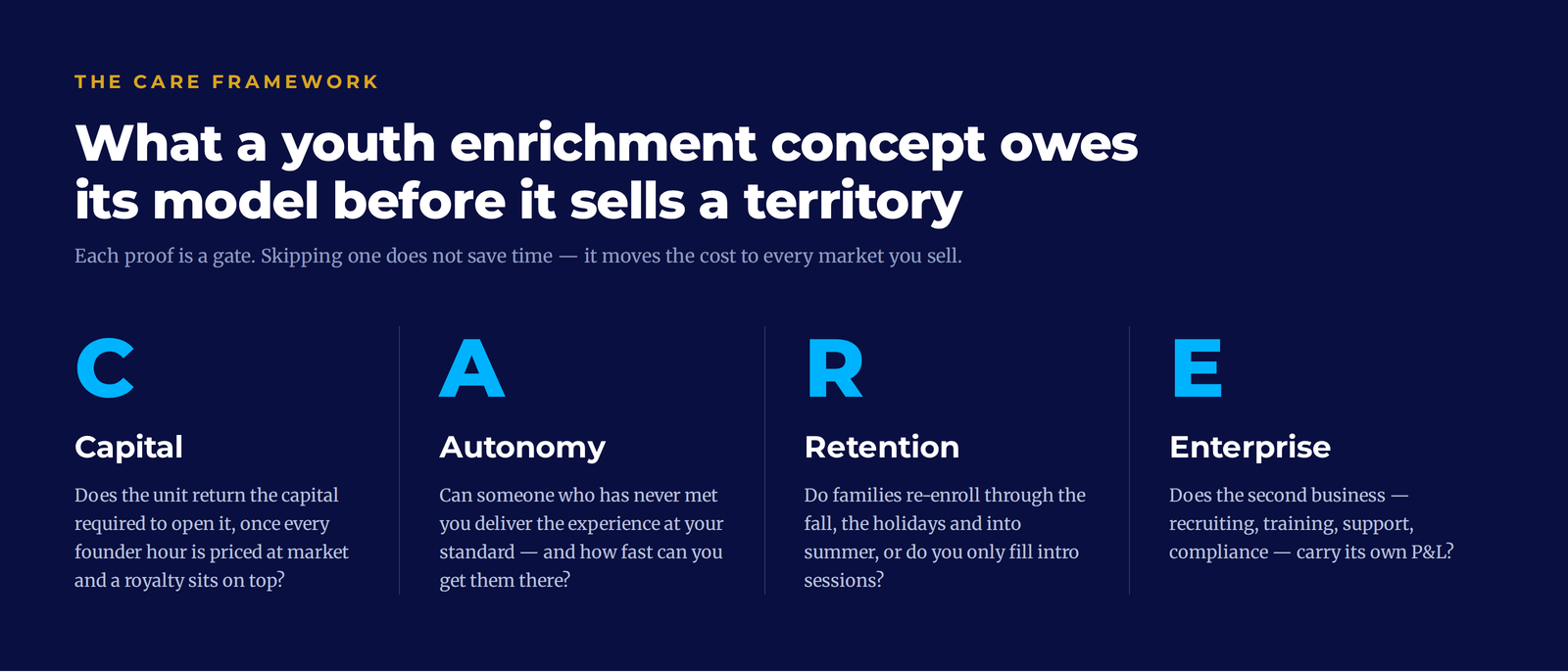
Figure 1 — THE CARE FRAMEWORK
C Proof One: Capital
Almost every single-unit youth concept is quietly subsidized by its founder. You teach the Saturday sessions yourself. You cover the front desk when an instructor calls out sick. You don’t pay yourself a market wage, and you may not be paying market rent.
None of that transfers. Your franchisee is putting real money at risk — often their savings, sometimes a loan secured against their home — and they will pay a general manager, a full instructor roster, market rent, and a royalty on top of all of it.
So rebuild your profit and loss statement honestly. Price every hour you personally work at what you would pay someone else to do it. Then answer the only question a serious candidate is actually asking: does this unit return the capital required to open it, on a timeline a reasonable person would accept, while paying its owner a salary? If it doesn’t, you don’t have a franchising problem. You have a model problem, and franchising will multiply it across every market you sell.
A Proof Two: Autonomy
Youth enrichment is a people business. The product is a person in a room with children, which makes autonomy the hardest proof in our category.
The test is simple and uncomfortable: can someone who has never met you deliver your experience at your standard, and how long does it take to get them there?
If your curriculum lives in your head, or in the one instructor everyone calls “the good one,” you have talent — not a system. Write it down. Session plans, coaching language, progression logic, and the specific moments that make a parent feel the tuition was worth it. Then hand it to somebody new, stay out of the room, and listen to what families say afterward.
Safety standards deserve their own mention here. Ratios, supervision, background screening, and incident protocol cannot be left to franchisee discretion. In a children’s business, one bad operator is a brand event, not a unit event.
R Proof Three: Retention
In our category you serve two customers. The parent pays. The child decides whether you keep them.
Enrollment is easy to buy. Any concept can fill an introductory session with paid advertising and a discount. Retention is what determines whether a franchisee survives — whether a family stays through the fall, comes back after the holidays, and re-enrolls for summer.
Look at your calendar honestly, too. Most youth concepts carry real seasonality built around the school year, with cash troughs a founder has learned to absorb and a first-time owner has not. A franchisee opening in October needs to know what January looks like before they sign.
Measure cohort retention, visit frequency, revenue per enrolled child, and capacity utilization. Bring those numbers to a franchise candidate and you are having a business conversation. Bring an enrollment count and you are handing out a brochure.
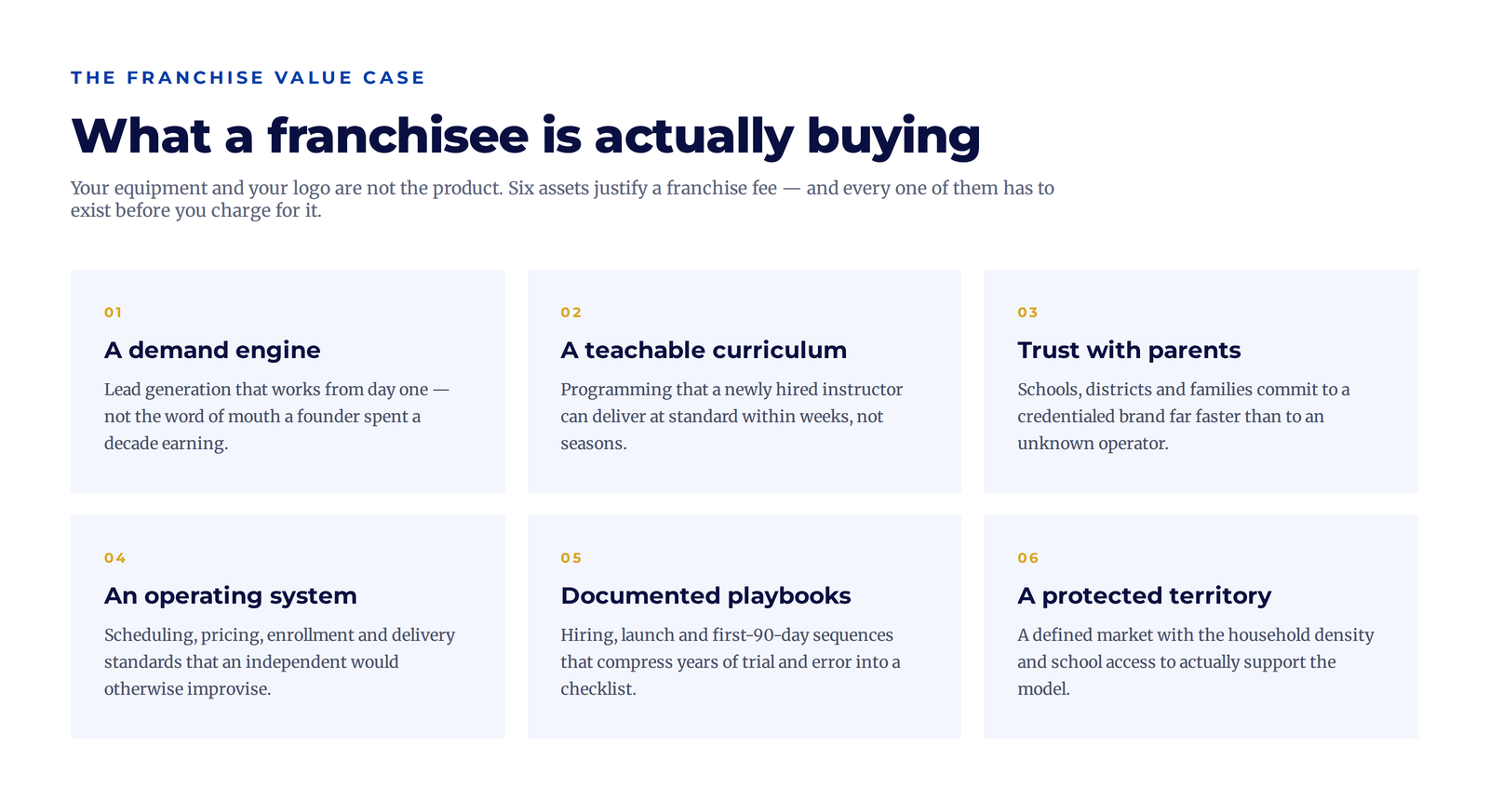
Figure 2 — WHAT A FRANCHISEE IS ACTUALLY BUYING
E Proof Four: Enterprise
This is the one founders never see coming. When you franchise, you are not expanding your business. You are starting a second enterprise that has almost nothing in common with the first.
Your customer is no longer a parent. It is a franchise owner. Your product is no longer classes — it is recruiting, training, field support, compliance, marketing systems, and technology. That business carries its own payroll, its own overhead, and its own losses in the early years, well before royalty revenue covers them.
Model it before you commit. How many open units before support pays for itself? What does a field team cost? Who answers the phone at seven o’clock on a Tuesday when a franchisee’s lead instructor quits? Founders who skip this end up funding franchise support out of a corporate operation that is shrinking because nobody is running it anymore.
It is also where the value you are building actually accumulates. A franchisor is worth some multiple of units, multiplied by average unit volume, multiplied by royalty rate. Every one of those three terms is set by decisions you make long before the first territory sells.
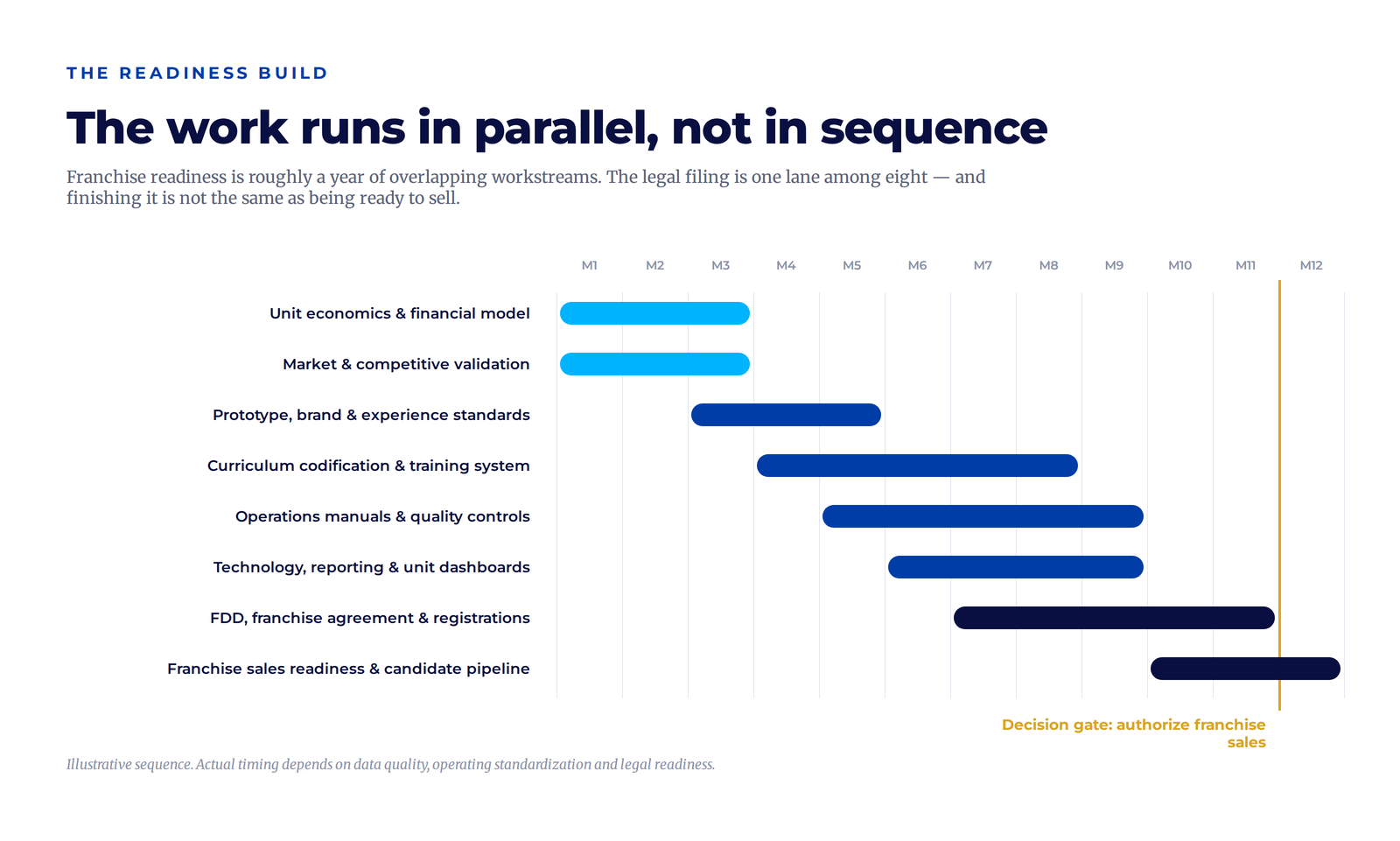
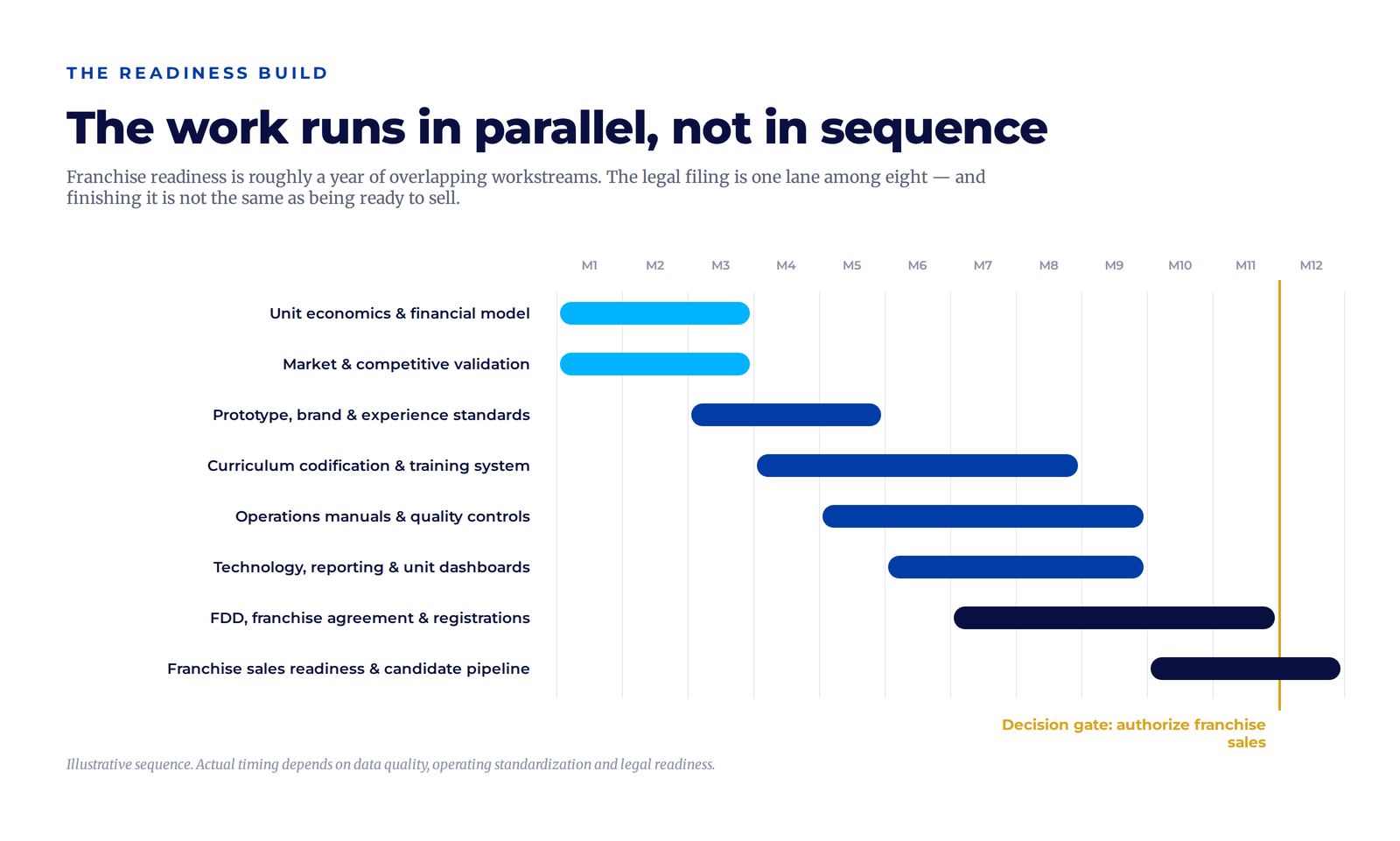
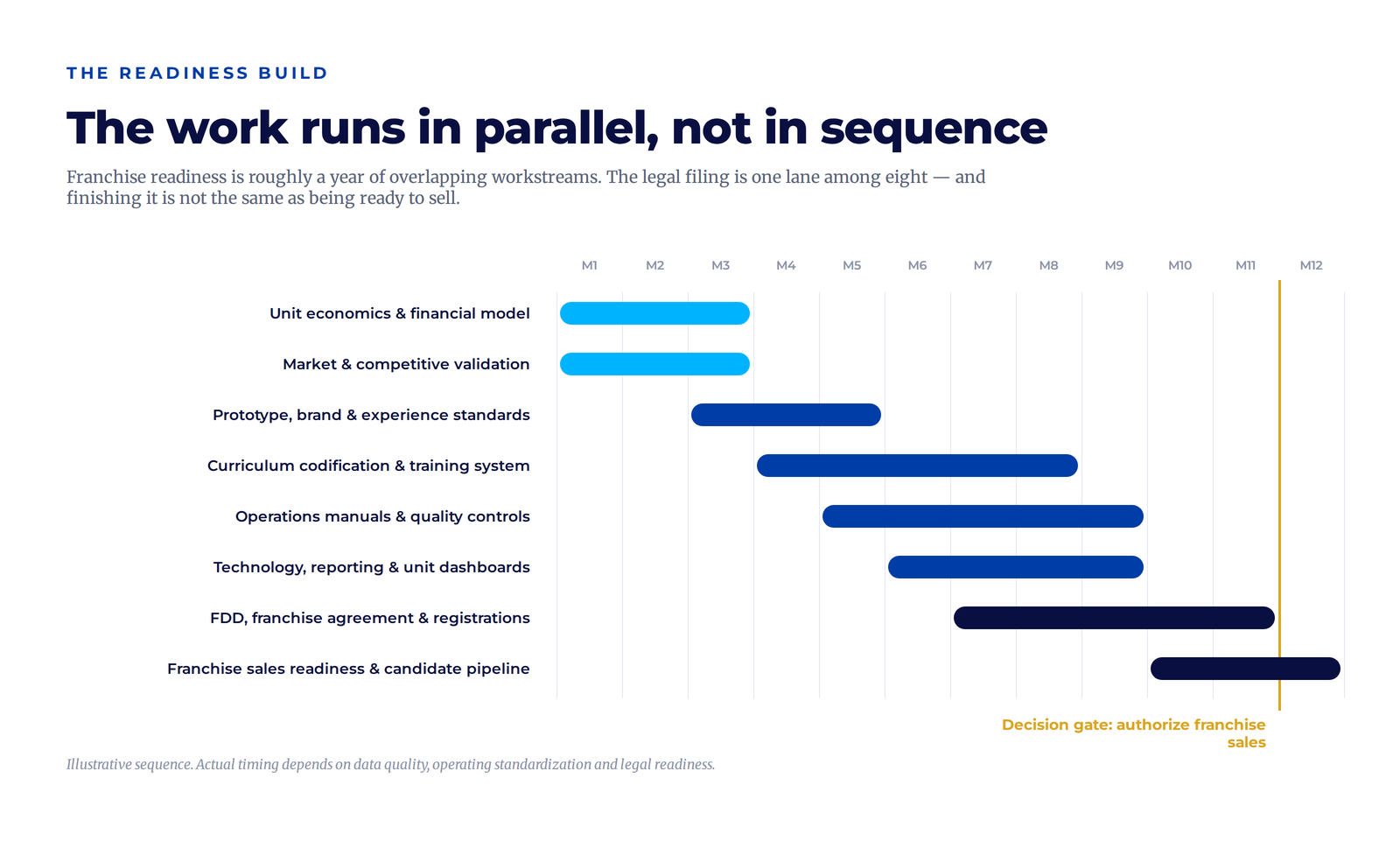
Figure 3 — THE READINESS BUILD
Earn the Right to Sell
One thing worth saying plainly: starting legal work is not the same as authorizing franchise sales.
There is nothing wrong with beginning your FDD, your operations manuals, and your training system while you finish proving the model. That work takes months and it should run in parallel. But the decision to sell belongs at its own gate, made on verified economics and demonstrated repeatability — not on the fact that your attorney finished drafting.
The founders who build systems that last are rarely the fastest out of the gate. They are the ones who spent two more quarters making the unit boringly repeatable, and then scaled something that held together at fifty units.
Your program works. That was the hard part, and you have already done it. Everything from here is proving that it still works when you are not in the room.

Figure 4 — THE WHEELHOUSE TEAM
Justin Nihiser is Managing Partner of Wheelhouse, a franchise consultancy working exclusively with youth enrichment brands across sports, swim, music, STEM, arts, and tutoring. He previously served as CEO of Code Ninjas, COO of Brain Balance, and Vice President at School of Rock.