
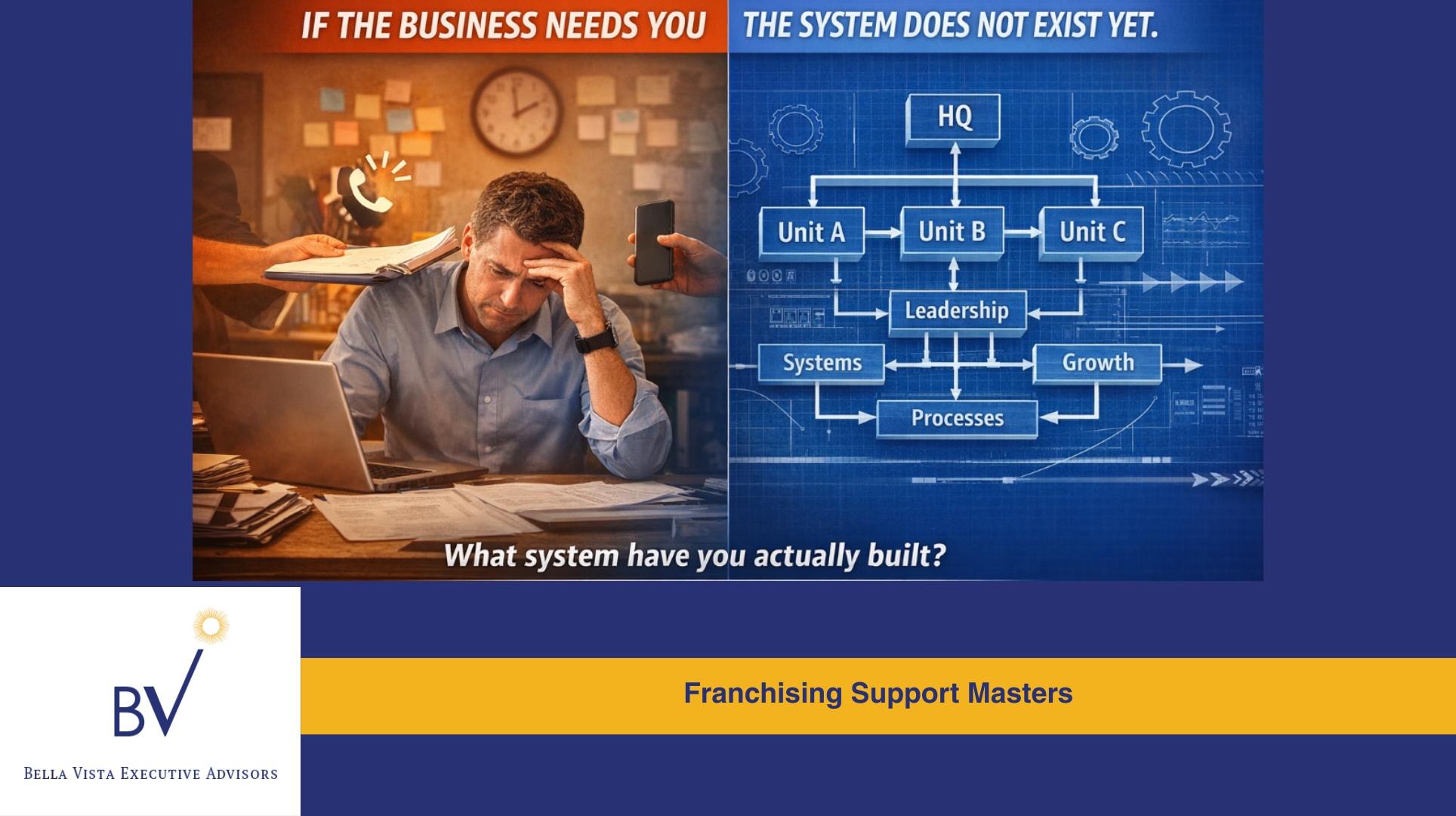
Many founders think scaling means three things: more locations, more people, and more revenue. The logic feels straightforward because growth is often measured by expansion.
But growth does more than test market demand. It tests the systems that run the organization.
Every new location increases pressure on those systems. Processes stretch, communication slows, decision authority blurs, and eventually the founder may discover that the organization still depends too heavily on them.
That dependence might work at one location or three. It becomes much harder to sustain at twenty.
The Leadership Shift
Throughout this year, I have explored a progression many founders experience:
Employee → Owner → CEO
Each stage expands responsibility and changes how the leader interacts with the organization. The final shift is often the most difficult because the CEO stops operating primarily inside the system and begins designing the system others will operate.
That shift changes how leadership should be measured. The founder is no longer evaluated mainly by how well they execute tasks, but by how well the organization performs without their constant involvement.
This is where many growing companies stall. The issue is usually not work ethic; it is that the founder never fully makes the transition.
Step 1 | Employee Mindset
Employees work inside the system. Tasks are defined, expectations are clear, and success is largely measured by how well the playbook is executed.
The responsibility scope is execution. Someone else created the structure, established the standards, and determined the priorities.
There is clarity in that role, and most careers begin there.
Step 2 | Owner/Operator Mindset
Owners begin managing the system. They coordinate work, assign responsibility, and solve problems when things break through scheduling, staffing, performance oversight, and daily operating decisions.
The responsibility scope becomes operations. Many founders remain here for years because they become skilled operators who can keep the business running day to day.
But operating the system and building the system are not the same thing. As the organization grows, operating skills alone become less sufficient.
Step 3 | CEO Mindset
The CEO does something different. The CEO designs the system others will operate and stewards the organization as it develops.
That means defining standards, decision rights, leadership structure, operating cadence, and expectations for growth. The responsibility scope becomes architecture and leadership stewardship.
This role can feel less tangible than solving problems directly. Yet it increasingly determines whether growth produces greater capability or greater dependence on the founder.
Organizations expand through structure, not personality.
Strong operating systems create leverage and repeatability because people understand what matters, who owns what, and how decisions should be made. Research on organizational performance has long reinforced the value of strategic alignment, disciplined resource allocation, and clear operating structures.¹
The Hidden Risk
If the founder does not intentionally design the system, the organization creates one. It often develops informally through habits, workarounds, relationships, and whatever path creates the least resistance in the moment.
At first, the signs may seem manageable: decision confusion, leadership bottlenecks, founder exhaustion, or inconsistent results across locations. Over time, those conditions become harder to compensate for.
The problem is not always that customers disappear or employees stop trying. The system may simply be carrying more weight than it was designed to handle.
Organizational-change research has repeatedly shown how difficult transformation becomes when leadership alignment, structure, and operating discipline are weak.² The lesson for a growing business is straightforward: improvisation can solve a problem today, but it does not automatically create capability for tomorrow.
What Pressure Reveals
One night, the Terrace Park Fire Department responded to a commercial structure fire just after midnight. The initial strategy was straightforward: attack the seat of the fire and protect the neighboring buildings.
Then the situation changed. The fire pushed through the roof, and a wind shift sent embers toward an adjacent building.
At that point, we had a choice. We could continue concentrating on the fire we started with, or we could redirect resources toward the emerging threat that could spread the fire throughout the block.
We shifted resources and protected the neighboring building first. Within minutes, the secondary threat was contained.
That experience reinforced something I have seen repeatedly in business:
Systems under pressure reveal whether the structure is strong enough.
When the system is not designed to handle the load, the leader often becomes the system by default. That may solve the immediate problem, but it is rarely sustainable.
The CEO’s Job
A strong CEO defines the structure others rely on. That means creating clear standards, decision authority, leadership expectations, and rhythms of communication and accountability.
When those elements are clear, teams understand what matters and leaders know what they own. Growth becomes easier to interpret because the organization is not depending on the founder to resolve every exception.
When that structure is missing, most decisions flow upward. Problems wait for the founder’s input, and every additional location increases pressure on the same person.
That model eventually reaches a limit.
The Anchors Only the CEO Owns
Founders eventually discover that some responsibilities can be delegated while others still require CEO ownership. Earlier in this series, I described three anchors every CEO must own:
Standards and culture. People. Money.
These are not simply operational tasks. They are structural responsibilities that influence how the organization behaves when the founder is not present.
Standards define how the brand shows up in the marketplace. People determine whether the organization has enough leadership depth to support growth, while money determines whether the business has the financial discipline and resources to sustain it.
When any one of those anchors weakens, the entire organization feels the effect.
In franchising, the pattern becomes especially visible. A franchisor CEO protects brand standards so multiple locations can deliver a consistent promise, develops leadership capacity so decisions do not bottleneck at the top, and protects the financial health needed to support franchisees and continued growth.
The same principle applies to a multi-unit franchise owner. Culture, leadership pipelines, financial discipline, and standards must become more transferable as the organization expands.
The common thread is that these responsibilities shape the structure of the system rather than the daily operation of the business. They influence how the organization performs long after the founder leaves the room.
A Question for Leaders
Ask yourself one question this week:
What system anchors in my business can only be owned by me?
Not supervised. Not delegated. Owned.
Clarity around that question often reveals both the founder’s next stage of leadership and the places where the organization still depends too heavily on them.
Founders who continue solving every problem personally can become trapped inside the system they built. The better question is whether each leadership decision is increasing organizational capability or reinforcing dependence.
Closing Thought
Growth rarely fails because people were unwilling to work hard enough. More often, growth exposes the limits of the system carrying the work.
Strong CEOs eventually understand that they are stewards of the business. Their responsibility is not simply to keep the organization moving, but to design and strengthen the structure that allows other people to lead, decide, and execute well.
When that structure becomes clearer, leadership can multiply, decisions can move closer to the people responsible for them, and the organization becomes less dependent on constant founder intervention.
The CEO’s job is to remove themselves from the system and build and steward the system the organization can grow into.
Questions to Consider
If your business doubled in size over the next three years, which decisions, standards, or responsibilities would still depend on you? What systems are stretched?
The answers tell you more about your readiness for growth than the number of locations you plan to open.
#Franchising #FranchiseLeadership #BusinessGrowth #SystemsThinking #FranchiseDevelopment #EntrepreneurLeadership #ScalingBusiness #FranchiseStrategy #LeadershipDevelopment #SmallBusinessGrowth #OrganizationalElasticity
Sources
Reeves, Martin & Haanaes, Knut. Strategy Needs a Strategy. Boston Consulting Group, 2014.
McKinsey & Company. Organizational transformation research, 2015.