

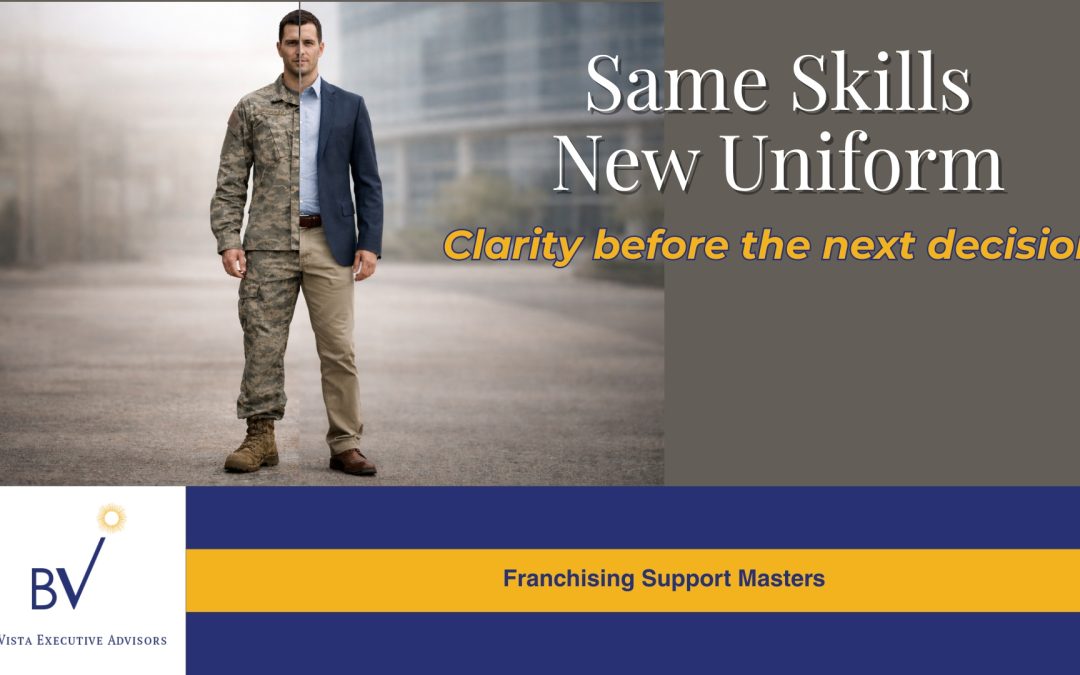
So here we are in a new year full of hope and uncertainty.
You’ve spent years proving you’re reliable, consistent, and valuable.
You roll up your sleeves when things break.
You show up when it matters.
Not everyone does that with your consistency.
Those are assets, not your ceiling.
I know this terrain personally. After retiring from the fire service in 2018 and selling my franchise business, I spent the next couple of years in what I can only describe as a professional fog.
I knew I was capable. I just didn’t know how those capabilities translated outside badge numbers, ranks, and laundry delivery routes.
In 2020, I started working with a career coach. Something clicked.
My experience stopped feeling like a résumé with gaps.
It started feeling like a toolkit.
This article starts there.
With a simple idea that sounds obvious, but rarely is: Your career story is an asset, unless you frame it like a ceiling.
This is the first step in a framework I’ll unpack over the next several issues in this column and on an upcoming podcast I’m co-hosting. We’re not naming the podcast yet, so consider that a teaser, not a pitch.
Why This Matters
If you’re transitioning from long-term employment, military service, or first response work into business ownership or a new career path, there’s a familiar fog that shows up.
What are my skills worth in the private sector?
What comes next?
How do I translate decades of service into something meaningful now?
That fog isn’t weakness.
It’s conditioning.
For years, your value was measured by compliance. Follow instructions. Execute the plan. Integrate into and follow the systems.
That’s how employees are trained. Military and civilian alike.
Business owners and CEOs are measured differently. They aren’t evaluated on how well they followed the plan.
They’re evaluated on the plans they build and leading others to execute the plans.
Same person.
Different scorecard.
We’ll walk that shift systematically.
Today, we start with how you tell your story to yourself first because earned confidence is the key.
A Look at the Landscape
Before we zoom in on your personal narrative, it helps to anchor this reality.
Veterans are not outliers in entrepreneurship. In fact, they’re significantly more likely to pursue self-employment than non-veterans. One widely cited study found that veterans are about 45% more likely to be self-employed than their civilian peers.
There are nearly 1.9 million veteran-owned businesses operating in the U.S. today. Together, they generate over $1.3 trillion in annual revenue and employ millions of people.
Translation, this transition isn’t theoretical. It’s been done repeatedly.
You have a unique story and skillset but you’re not an anomaly.
That said, there’s nuance here. Veteran business ownership rates have shifted over time as demographics change and access to capital and civilian pathways evolve. Data alone doesn’t guarantee outcomes.
Which is why this matters: The data doesn’t decide your future. How you frame your experience does.
Shift Your Frame (Without the Fluff)
Here’s a subtle trap many transitioning professionals fall into.
They describe what they were instead of what they did.
“I’m a Sergeant.”
“I’m a Lieutenant.”
“I spent 20 years as a firefighter.”
That’s how employees describe themselves, with titles, roles, and functions.
Here’s the CEO lens: Those are outputs, not impact.
Decision-makers think in terms of decisions made, problems solved, risks managed, systems improved, and people led. That’s how capability is recognized whether you’re starting a business or stepping into a new career lane.
So this week’s task is simple.
It’s not easy, and may be a bit uncomfortable. Growth happens here.
Action Step: Rewrite Your Career Story
Take a few minutes in your quiet time, and rewrite your career story in three clean bullets.
No titles.
No ranks.
No departments.
Not this:
- “I was an Army Captain.”
- “I was a Fire Lieutenant.”
Try this instead:
- Led teams through high-stress situations with real consequences.
- Designed and executed real-time strategies under uncertainty.
- Managed people, equipment, and budgets with zero tolerance for failure.
That’s the difference between history and transferable impact.
That’s how owners think.
That’s how decision-makers gauge capability.
If this feels uncomfortable, good. That’s a sign you’re changing lenses. When you change the lens, you change what you notice, and that’s where clarity starts.
Why This Is the First Step
This isn’t theory.
It’s not a motivational poster.
It’s drafting your mental model. The one you’ll use when things get ambiguous.
Our brains are literal. If your internal script still says, “I was an employee,” your future behavior will keep defaulting to employee patterns, even if you own the business or hold the title.
This exercise isn’t about ego. It’s about clarity of capability.
Clarity, aka self-awareness, always comes before good decisions.
A Quick Podcast Tease
Beginning in January 2026, I’m co-hosting a new monthly live podcast series focused on people standing exactly where you are.
Not selling outcomes.
Not pushing ownership.
Not dismissing career paths.
Illuminating options clearly explained.
Clarity before choice.
We’ll shine light for veterans and first responders who are navigating this transition on different timelines and in different directions. Same questions. Different answers.
Think of this newsletter as the framework. The podcast brings the lived experience.
Together they’re possibilities in action.
Close
This week isn’t about choosing a path.
It’s recon to see the terrain clearly.
#CareerTransition #VeteranToCEO #LeadershipMindset #BusinessOwnership #WeeklyShift #94XMovement
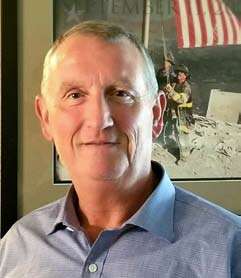
Lucas Frey: Franchise Leadership Expert and Author
Lucas Frey is a seasoned franchise strategist with over two decades of experience in leadership and business development. His journey from the front lines as a fire chief to the helm of his own successful franchise has equipped him with unique insights into the challenges and triumphs of franchise ownership. As the author of Your Guide to 90-Day Success: The Franchisee’s Strategy for Early Wins, Lucas empowers franchisees to achieve early wins and sustainable growth by shortening the steep learning curve of business ownership.
Passionate about helping others succeed, Lucas offers actionable strategies that blend practical business acumen with a deep understanding of human dynamics. Through his work, he’s committed to shaping the future of franchising, one successful business at a time.