

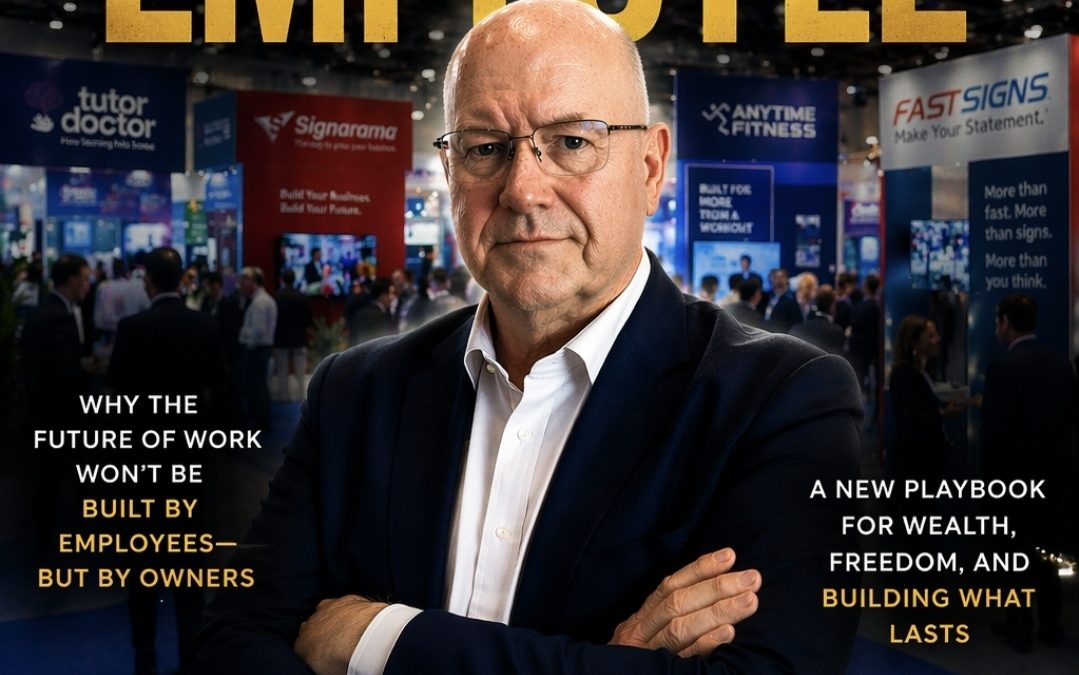
They called it progress.
Leave the farm. Leave the shop. Leave the trade your family built across generations and come work in the factory. The machine needs you. The economy needs you. This is the future — organized, efficient, modern. A paycheck instead of a harvest. A boss instead of a birthright. Security instead of ownership.
And so they came. By the millions. They left the land and the family business and the community where their name meant something, and they traded it all for a wage. For stability. For the promise that if they showed up, worked hard, kept their heads down, and gave the machine their best years — the machine would take care of them.
That was the deal.
The Industrial Revolution didn’t just reorganize the economy. It reorganized the human being. It took people who had always been owners — of land, of tools, of trade, of their own labor and its fruits — and reclassified them. Made them employees.
Dependent. Interchangeable. Optimized for someone else’s production schedule and someone else’s quarterly number.
And then — this is the part that should make you angry — it told them this was normal. This was success. This was what a good life looked like.
Go to school. Get a job. Build a career inside someone else’s organization. Spend your best decades making their numbers move in the right direction. Hope that when you are no longer useful, the severance is sufficient.
One hundred and fifty years of that story.
One hundred and fifty years of human beings building empires for other human beings, and being told to be grateful for the opportunity.
And now — right now, in this decade, in this moment — the story is ending.
Not because a movement rose up and demanded it. Not because a politician promised it. Because the machine itself changed. AI and automation are doing what industrial technology has always done: eliminating the roles that humans were conscripted to fill. The analysts. The coordinators. The middle managers. The knowledge workers who spent decades building careers around skills that are now being automated at a price that undercuts any salary.
The machine no longer needs you the way it used to.
And that — that displacement, that disruption, that thing that looks like a crisis from inside the system — is actually the opening.
Not just for individuals. For an entire industry that has been waiting, without knowing it was waiting, for exactly this moment.
For a hundred and fifty years, franchising was treated as a category of business. A legal structure. A way to replicate a proven concept across multiple locations. Important, but narrow. An industry within the economy. Interesting to some. Relevant to a few.
That framing was always wrong. We just didn’t have the context to see it clearly until now.
Franchising was never a category of business. It was a prototype — the first systematic proof that ordinary people, given a proven framework and the right support, could build enterprises that generated real wealth, served real communities, and created real legacy. While the Industrial Revolution was busy converting owners into employees and concentrating wealth upward into distant corporations, franchising was quietly doing the opposite. Distributing the infrastructure of success to individuals. Keeping ownership local.
Proving, location by location and decade by decade, that the person on the ground — the owner with skin in the game, with their name on the door, with genuine care for the customer standing in front of them — could outperform the managed, optimized, centralized corporate alternative.
Franchising was the answer before we fully understood the question.
The question is now fully visible.
AI is displacing white-collar workers at scale. The corporate contract is broken beyond repair. Ten trillion dollars in Boomer-owned businesses is coming to market without qualified buyers. The trades — the physical, local, human-centered work that no algorithm can replicate — are desperately short of the organized, capitalized, systematized operators who can scale them to meet the demand that AI’s physical infrastructure requires. A nearly trillion-dollar industry, already proven across 830,000 locations and 8.8 million jobs, is growing at twice the rate of the broader economy.
Every one of these forces points in the same direction. Toward local ownership. Toward proven systems. Toward the individual entrepreneur embedded in their community — with a brand, a framework, and a support network behind them.
Toward franchising.
Not franchising as a category. Franchising as the architecture of the next economy. That is the argument of this book. Everything else is evidence.
For a hundred and fifty years, franchising sat inside the economy as a structure. What is happening right now is different. The forces converging around it — the AI displacement, the Boomer succession wave, the trade shortage, the breakdown of the corporate contract — are not forces that franchising is responding to. They are forces that franchising was built to answer. The industry didn’t know this was its moment. But the moment has arrived anyway, and the industry is already in position.
The Industrial Revolution pulled people away from their families and their communities and their own enterprises to serve the money machine. The machine told them that employment was progress, that the wage was security, that the career was an identity worth building.
What is happening right now is pulling them back.
Not in defeat. Not as casualties of a disruption they couldn’t see coming. As owners — back to their communities, back to their families, back to the fundamental human truth that the most durable security, the deepest relevance, and the most transferable legacy have always come from building something of your own.
And the instrument of that return — the proven, systematized, scalable framework that makes it possible for ordinary people to build extraordinary things — has been here all along.
Just enough is the most sophisticated trap ever built. It doesn’t arrive as a threat. It arrives as relief. Just enough salary to not leave. Just enough stability to not risk. Just enough comfort to make the cost of staying invisible until the cost has already been paid. The Employment Universe runs on just enough the way a machine runs on fuel — it is the energy that keeps people inside it, building someone else’s empire, one just-enough year at a time.
Just enough was the Employment Universe’s primary weapon. Just enough salary to stay. Just enough stability to not move. Just enough comfort to make the cost of inaction invisible. The corporate machine perfected just enough as a mechanism of control — keeping people productive without giving them enough to build anything of their own.
Franchising breaks that. Not by promising unlimited upside. By providing a proven path from just enough to something real. From the employee trading time for income to the legacy owner whose relevance is permanent, whose systems are transferable, whose family inherits not just money but the framework for creating it. Just enough becomes limitless — not through a leap of faith, but through a structure. A hierarchy. A map.
Knauf’s Hierarchy of Franchising is not a franchise framework. It is the architecture of the unwinding. The path from the detour back to the destination. Six levels from the Employment Universe to the apex of the owner class. Six levels that trace the same arc the human story has been trying to complete for a hundred and fifty years.
This is not a business book.
This is the argument that a nearly trillion-dollar industry just found its purpose — and that the people who understand that right now, before the window narrows, before the Boomer businesses are absorbed by private equity, before the trade shortage reaches crisis — are not buying franchises.
They are positioning themselves at the front of a civilizational shift.
This is not the end of something. This is the completion of a cycle that has been running for a hundred and fifty years. The people who see it clearly — right now, in this moment — are the ones who get to ride it all the way home.
Here is what we have forgotten.
Before the factory, the farm was not just a place to grow food. It was an enterprise. The farmer owned the land, the tools, the output, and the relationship with the market. The family was the organization. The legacy was the deed. The business and the life were not separate things — they were the same thing, conducted in the same place, for the same people, across generations.
The craftsman’s shop was not just a place to make things. It was an identity, a community anchor, and a vehicle for wealth that compounded across decades. The blacksmith who built a reputation in a town was relevant in that town in a way that no employer could grant and no restructuring could revoke. The baker’s children knew how to bake. The cooper’s apprentice became the cooper. The trade was the inheritance.
The merchant’s trading relationships were not just business connections. They were the accumulated trust of years of showing up, delivering what was promised, and treating partners with the integrity that made the next deal possible. That trust was worth more than any single transaction. It compounded. It transferred. It was, in the deepest sense, a form of capital — one that belonged entirely to the person who built it.
The Industrial Revolution told all of these people that their way of life was inefficient. That the factory could produce more, faster, cheaper. That the organization of labor under central management was the superior model. That the individual enterprise was quaint, limiting, and destined to be superseded by the corporation.
Some of that was true. The factory did produce more. The corporation did scale in ways that individual enterprises could not. The efficiency was real.
What was not true was the claim that followed: that the exchange was fair. That trading the ownership, the legacy, the identity, and the community anchor of individual enterprise for a wage and a benefits package was progress rather than loss. That the employee, building the corporation’s wealth with their best years, was participating in something that would ultimately compound in their direction.
It did not compound in their direction. It never did. It was designed not to.
The corporation captured the efficiency gain. The employee received the wage. The gap between those two things — between what labor produced and what labor received — is the source of every stock option, every carried interest, every private equity return, every billion-dollar exit that has ever been celebrated in the business press. The celebration is of the gap. The gap was always the point.
And for a hundred and fifty years, the people on the wrong side of that gap were told — by the schools that prepared them, the employers that hired them, the culture that surrounded them — that this was normal. That this was success. That the wage, the benefits, the title, the retirement plan were the reward for a life well-lived in service of someone else’s enterprise.
The Franifesto is the argument that this was wrong.
Not wrong as a matter of moral judgment about the people who designed the system. Wrong as a matter of historical fact about what it cost the people who lived inside it. Wrong in a way that is now, for the first time in a hundred and fifty years, being corrected — not by revolution or redistribution, but by the simple and unstoppable fact that the machine has changed what it needs from human beings, and in that change, has opened a door that was closed for five generations.
Franchising is what walks through that door.
Not because franchising invented the concept of local ownership — it didn’t. Not because franchising solved the problem of the corporate contract — it is one of many alternatives. But because franchising is the only model that combines the scale of a national brand with the local accountability of individual ownership. The only model that takes the operational infrastructure that used to require a corporation to build and puts it in the hands of a person who lives in a community and is answerable to it. The only model that has been systematically proven, across every economic condition of the last century, to work.
Eight hundred and fifty thousand franchise establishments. Nine million jobs. Three percent of the GDP of the largest economy in the history of human civilization. Built by people who chose, one by one, to walk through the door.
The Franifesto is an invitation to join them.
Not as an act of rebellion against employment — some people will always choose employment, and that is their right. But as an act of clarity about what ownership offers that employment cannot: equity that compounds in your direction. Relevance that is earned rather than borrowed. A community that cannot restructure you out of existence. A legacy that transfers to the next generation as something real — not just memories of effort, but the ongoing fruit of it.
The Industrial Revolution pulled people away from ownership. The forces arrayed right now are pulling them back. AI displacement. The Boomer succession wave. The trade shortage. The breakdown of the corporate contract. All of it pointing toward the same model. All of it arriving at the same moment.
A nearly trillion-dollar industry has spent a hundred and fifty years proving the model. The moment has arrived to use it. The people who act on that understanding right now — before the window narrows, before the Boomer businesses are gone, before the trade shortage resolves, before the next cohort of corporate refugees discovers what you are discovering in these pages — will look very different in ten years from the ones who nodded along and waited.
This can be our victory lap.
— George Knauf
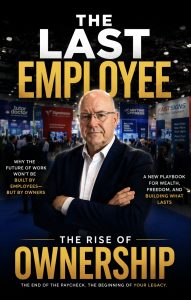
You can order your copy of George’s book to learn more and enjoy this fascinating read: