

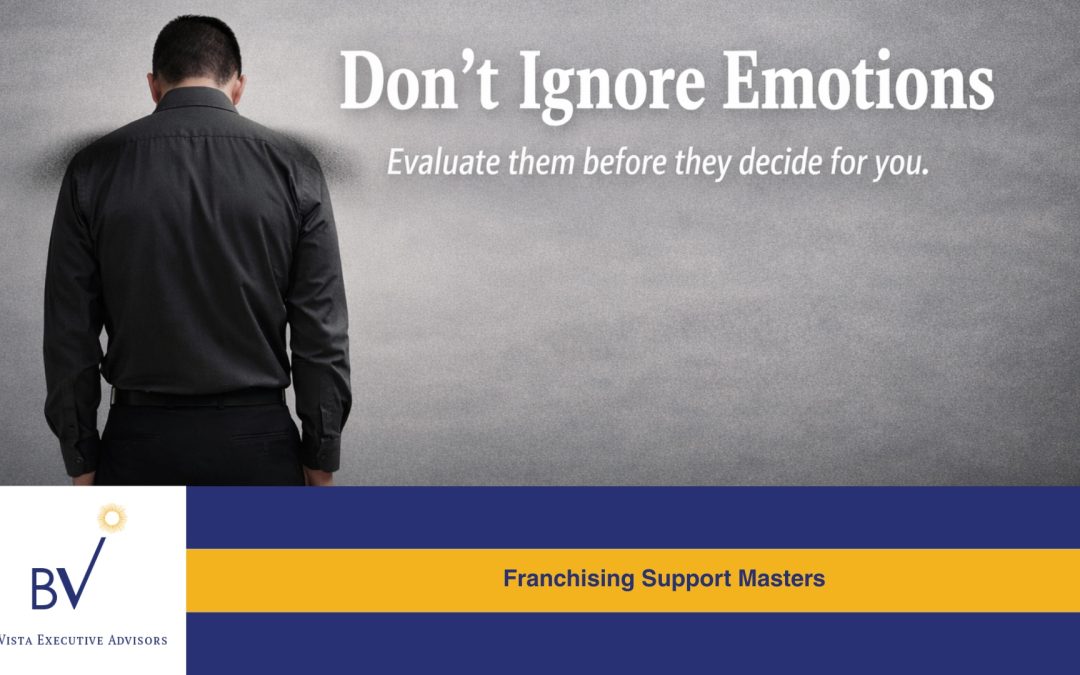
My grandfathers were stoic men. They were good men. Both owned local service businesses and were hardworking, reliable, and steady. They taught me, directly and indirectly, to keep emotions in check, to handle what needed to be done without making things complicated. For a long time, that approach worked.
Until it didn’t.
As a franchise business owner and later as a fire chief, I learned that emotions don’t disappear because you ignore them. They go underground. And when emotions go underground, they don’t stay quiet. They show up in tone, timing, and decisions, usually when you least want them to.
The shift for me wasn’t becoming more emotional. It was becoming more self-aware. Recognizing the emotion, accepting that it was present, assessing why it showed up, and then using that information intentionally became a leadership skill. One that helped me lift up my teams and better serve the people we served.
From Identity to Internal Pressure
Last week, we talked about identity. Specifically, reframing your career story from a ceiling into an asset to support what comes next. That shift matters more than most people realize.
This week is about what shows up after that identity shift. Once you stop seeing yourself as “the operator,” the “good soldier,” or “the employee,” responsibility increases, and insulation decreases. That’s when emotions grow louder, not because something is wrong, but because more is at stake.
Emotions don’t disappear with growth. They change roles.
The Employee Emotional Environment
In most employee roles, corporate, military, or franchise operator, the emotional environment is predictable. Safety and approval matter. Certainty becomes a form of currency. Your decisions are rarely final, and there is almost always a corporate or organizational safety net.
Someone upstream absorbs the risk. Policies exist for escalation. Consequences are shared.
Those emotions aren’t weaknesses. They are appropriate to the role. You weren’t avoiding responsibility. You were operating inside a system designed to distribute it.
The Emotional Shift Most People Don’t Expect
Ownership changes the emotional math. Buffers disappear. Decisions feel heavier because they are heavier. No one else absorbs the consequences, and there is no longer a place to forward the email.
This shows up quickly, whether you’re a franchise owner choosing a location, a franchisor deciding when to hire your first franchise developer, or a founder determining where to establish a banking relationship. Even decisions that once felt minor now carry weight.
That isn’t a flaw in ownership. That’s the point.
Owner Emotional Realities
Here’s the honest trade that comes with accountability:
- Responsibility replaces safety.
- Exposure replaces approval.
- Solitude replaces certainty.
This happens immediately, and it happens inevitably. Every decision has consequences, including the ones that don’t feel dramatic at the time. The absence of a safety net is what creates leadership growth and it explains why emotions feel sharper.
A CEO Truth Worth Saying Out Loud
Discomfort increases with authority. If discomfort isn’t increasing, authority isn’t either.
Top 1% CEOs aren’t calmer because they care less. They’re calmer because they’ve learned how to operate while discomfort is present. This is also where impostor syndrome shows up, and that matters.
Impostor syndrome is not a reason for failure. It’s a strategic indicator. It highlights the leadership skills being stretched and refined. It doesn’t mean you’re unqualified. It means you’re operating at a new level.
Normalizing the Experience
Feeling uneasy doesn’t mean something is wrong. It often means you’re closer to the edge of growth. That edge is where CEOs operate, and it’s rarely comfortable.
If you never feel exposed, you’re playing too small. If you never feel uncertain, you’re deferring decisions. Growth doesn’t eliminate emotion. It requires a greater self-awareness to work with it.
Common Avoidance Patterns
Avoidance seldom looks like avoidance. It often shows up as delay disguised as “thinking it through,” or persistent “I should” statements, or seeking advice from disinterested sources instead of making decisions. Sometimes it shows up as activity that feels productive but avoids ownership.
It feels responsible. It feels prudent. It’s often fear wearing a productivity costume.
This Month’s Action
Name one emotion that consistently shows up for you over the last few months. Write it down. Next to it, list your decision options.
Many clients tell me, “I know what I should do. I want to be sure.”
Then make the decision, balancing risk and impact. Not recklessly, rather intentionally. There is never perfect information and not every decision works out the way you expect.
Action is the key. Test, measure, and adapt to sharpen the decision for long-term success.
You don’t need perfect confidence. Perfection isn’t possible. You need clarity and progress toward your vision.
Your CEO Growth
Clarity doesn’t remove emotion. It teaches you how to recognize it, evaluate why it’s present, and act with it in the room. That’s the upgrade, and you don’t have to do it alone.
Closing
Last month was about reframing your story. This month is about leading yourself through discomfort. That’s CEO growth.
Next month, we’ll talk about how time changes hands when ownership begins, and why that shift determines whether growth feels empowering or exhausting.
#VeteranTransition #LeadershipDevelopment #CEOGrowth #BusinessOwnership #FranchiseOwner #ImposterSyndrome #DecisionMaking #WeeklyShift #94XMovement
Lucas Frey: Franchise Leadership Expert and Author
Lucas Frey is a seasoned franchise strategist with over two decades of experience in leadership and business development. His journey from the front lines as a fire chief to the helm of his own successful franchise has equipped him with unique insights into the challenges and triumphs of franchise ownership. As the author of Your Guide to 90-Day Success: The Franchisee’s Strategy for Early Wins, Lucas empowers franchisees to achieve early wins and sustainable growth by shortening the steep learning curve of business ownership.
Passionate about helping others succeed, Lucas offers actionable strategies that blend practical business acumen with a deep understanding of human dynamics. Through his work, he’s committed to shaping the future of franchising, one successful business at a time.