

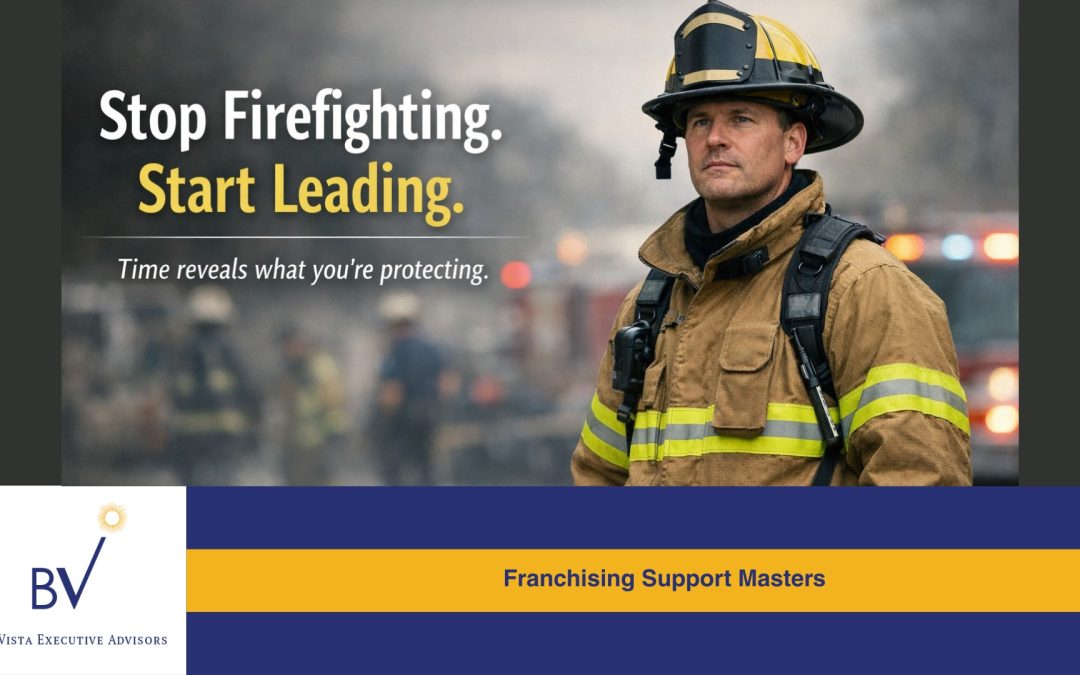
On an emergency scene, time isn’t neutral. Moments carry weight, and how the incident commander uses time impacts lives.
My priorities were clear and always in the same order: protect the fire crews working the scene, ensure public safety, and mitigate the dangers created by the emergency, whether that was an active structure fire, a car wreck, or pulling someone from the Little Miami River.
What mattered wasn’t how busy we were. It was how intentionally we used time. Crews could be working nonstop and still be moving the situation in the wrong direction if priorities weren’t clear. The same is true in leadership.
For business owners, franchise founders, and franchise CXOs, time is the most powerful resource you control; not capital, not strategy, time. How you allocate your time shapes decisions, culture, and outcomes for everyone working with you. When time is spent reacting, the organization reacts. When time is spent choosing, the organization gains direction.
This week’s conversation is about where leadership accountability shows up, not in intentions or values statements, but in how you spend your time and what that signals to the people depending on you.
When Accountability Increases, Busy Often Follows
As your accountability increases, emotions get louder. We covered that last week. What often goes unsaid is what many leaders do next.
They fill time.
When emotions get louder, calendars fill, meetings multiply, emails get answered faster, research deepens, and activity increases. It feels productive, responsible, and safe.
Busy feels like progress.
It often isn’t.
Employee Week: Time Is Assigned
In an employee role, whether corporate, military, or franchise operator, the week is largely predetermined. Your boss assigns tasks, meetings appear on your calendar, and time gets filled.
Employee success is measured by completion:
- Did you respond to your boss’s email requests?
- Did you attend the meetings others scheduled for you?
- Did you execute your weekly tasks?
There’s comfort in a full calendar. It signals usefulness. More importantly, it means someone else decides what matters. Responsibility is real, but it is distributed.
Those habits aren’t wrong. They are appropriate for the role.
Owner Week: Transitional Phase
Ownership introduces choice, but not mastery. You select priorities then override them when crisis pops up. Urgent requests crowd out important work. Time is partially protected, and easily breached.
This is where many franchise owners and founders stall. They’re accountable, but still reactive. They’re deciding, but mostly in response to someone else’s urgency.
It’s an uncomfortable middle ground; responsible, but not yet intentional.
CEO Week: Time Is Protected
CEOs measure weeks differently. They don’t ask, “What did we do?” They ask, “What value are we creating?”
Time becomes an asset to defend, not a container to fill. Meetings are fewer and with greater impact. Decisions carry more weight. White space isn’t laziness. It’s capacity for important functions.
Peter Drucker put it plainly: “Until we can manage time, we can manage nothing else.”
CEOs internalize that truth early, or they pay for it later.
The CEO Metric Most People Miss
The real metric isn’t hours worked. Your metric is what value you create.
One decision can save months of effort.
One avoided decision can quietly cost years.
This is where last month’s article connects directly. Discomfort shows up before high-value decisions.
That’s not coincidence. It’s protection.
Why Busy Becomes a Trap
Busy provides cover. Especially for leaders who were previously high-performing employees. It delays accountability without looking like avoidance.
Busyness shows up as avoidance patterns disguised as diligence: more emails, more research, more voices in the room.
Activity increases. Decisions stall.
McKinsey Global Institute found that knowledge workers (leaders are a subset) spend nearly 60% of their time on coordination, communication, and internal processes rather than value-creating work (McKinsey Global Institute, The Social Economy).
Busy fills the week. Value waits.
Busy is often fear wearing productivity clothes.
The Weekly Activity Audit
This is not a time-management exercise. It’s an awareness accounting.
For one week, track your work at a high level. Not every minute, just the tasks. At the end of each day, label them:
E – Employee-level: execution, response, maintenance
O – Owner/Operator-level: priority-setting, delegation, improvement
Don’t judge. Don’t optimize. Just label for now.
What Many People Discover
Their week is heavier on E than expected.
Their highest-stress moments cluster around O tasks.
Their most avoided tasks are usually the most valuable.
That’s not failure. That’s data, and data is where progress starts.
How This Fits the Framework
Month 1 reframed a leader’s identity from employee.
Month 2 reframed how emotional signals are amplified with greater responsibility.
Month 3 reframes time allocation.
You can’t think your way into CEO behavior.
You have to see how you’re spending your time. Awareness precedes change every time.
This Week’s Action
Track your activities for one week.
Label tasks E-employee or O-owner.
Circle one O task you avoided or delayed.
That’s your leverage point.
Don’t fix everything. Fix one thing.
Normalize the Experience
If this exercise feels uncomfortable, that’s expected. Awareness comes before improvement. You’re not behind. You’re earning clarity.
As Andy Grove said, “The output of a manager is the output of the organization.”
Your calendar is telling you what your output will be.
#LeadershipDevelopment #CEOGrowth #FranchiseOwner #FranchiseFounder #DecisionMaking #TimeManagement #WeeklyShift #94XMovement

Lucas Frey: Franchise Leadership Expert and Author
Lucas Frey is a seasoned franchise strategist with over two decades of experience in leadership and business development. His journey from the front lines as a fire chief to the helm of his own successful franchise has equipped him with unique insights into the challenges and triumphs of franchise ownership. As the author of Your Guide to 90-Day Success: The Franchisee’s Strategy for Early Wins, Lucas empowers franchisees to achieve early wins and sustainable growth by shortening the steep learning curve of business ownership.
Passionate about helping others succeed, Lucas offers actionable strategies that blend practical business acumen with a deep understanding of human dynamics. Through his work, he’s committed to shaping the future of franchising, one successful business at a time.